February 28, 2010
The flood control system for the Hudson River is being badly mismanaged, bringing threats of
damage, disease and higher taxes to Albany
Talk about an unpleasant surprise, a lightning bolt from a clear blue sky or a meteorite through the roof of your car. An obscure State regulatory agency located somewhere up north arbitrarily announced on January 12 that Albany County and the taxpayers of four other counties have to pony up millions of dollars in assessment costs. Yes, it’s extortion, but the obscure agency may very well be able to go to court and shake down the counties to cover their own spectacular mismanagement.
The agency is called…. are you ready for this?… the Hudson River Black River Regulating District, or the HRBRRD for short. The State workers back in the 1920s who came up with that acronym were thinking about springtime floods and deadly epidemics and relocating angry farmers from their river valley home. They were probably not thinking about how clunky HRBRRD would sound in the 21st Century.
The primary responsibility of the HRBRRD is to prevent flooding by the Hudson River. For most of the 20th century they did their job just fine. But now because of a combination of patronage, “privatization” and sheer incompetence, Albany can look forward to damage from recurring floods and the possibility of the outbreak of waterborne disease. And higher taxes.
 South Pearl Street In Albany’s South End, 1913
Some Forgotten History
Basically, the HRBRRD was created in response to the now mostly forgotten Great Flood of 1913 that ravaged the Northeast US. More specifically, the Flood caused the Typhus Epidemic of 1913 here in the South End of Albany, an epidemic that climbed up the State Street hill and gravely sickened some of our State and City leaders along with their families.
What was called “typhus” at the time is today called typhoid fever, two different diseases. This causes lots of confusion. Typhus is transmitted by lice, typhoid fever comes from drinking contaminated water although it can also be transmitted by contact with an infected carrier. Technically, the “1913 typhus epidemic” was actually an outbreak of typhoid fever.
At that time the Hudson River was an open sewer and would remain so until the rise of the environmental movement in the late 20th century. In 1913 the filthy river water overwhelmed a filtration plant on the waterfront, thus contaminating much of the City’s drinking water.
As epidemics go it was minor, less than 200 cases of typhoid fever in the City of Albany were reported to the authorities although the real figure was certainly much higher. The South End, poor, crowded and partially immersed in water, proved to be a breeding ground for the disease. If you were in good health and received good nutrition your chances of full recovery were good, much less if you were a poor slum dweller in the South End.
According to a Health Bulletin issued in May of 1913 at the end of the epidemic, exactly 75 percent of the reported cases of typhoid fever in Albany occurred in children. Strange to say, I can’t find any mortality statistics available for this epidemic. But it was understood at the time that typhoid fever had about a ten percent fatality rate. One out of ten victims were expected to die.
 The Famous Typhoid Mary (front left) quarantined in NYC 1909
In response, our elected officials from a hundred years ago decided that they would never let a flood and epidemic strike the South End and find their families ever again. Partly this was a concession to activists who were demanding that the government promote public sanitation, a policy that we all take for granted today. Certainly, in the spring of 1913 our civic leaders found out the hard way that conditions that affect the poor will eventually affect them and their families.
Thus Great Sacandaga Lake was created as the centerpiece of the State’s flood control system for the Hudson River. The Lake is a reservoir not for drinking but for storing water. The system is a beautiful piece of hydrology that works excellently when it is run by competent people. In fact it has worked so well until recently that most people don’t even know that the flood control system exists.
If you take a stroll down to Island Creek Park in the South End and stare into the Hudson, you should know that about forty percent of the water that you are looking at came down from the Adirondack Mountains via the Sacandaga River. The State engineers in the 1920s observed that the Sacandaga River was wildly erratic, varying from a raging torrent in spring to an unnavigable trickle by November. They understood that controlling the Sacandaga River is the key to controlling the Hudson.
In 1930 the dam up north at Conklingville was closed and the Sacandaga River valley flooded, creating a lake covering some 42 square miles with 125 miles of shoreline. At its widest part it takes me about two hours to cross by kayak. This is the Great Sacandaga Lake. The main task of the HRBRRD is to maintain the Lake and use the Lake to prevent flooding downstream in places like Albany.
Ideological Corruption
Lately the HRBRRD hasn’t been doing a very good job of maintaining the Lake. Okay, let’s not mince words here. For the past 15 years the persons running the regulating district have displayed such utter incompetence that the HRBRRD and the flood control system is on the verge of complete collapse. And the Lake itself is suffering from this incompetence along with the local communities.
 HRBRRD’s Assessment Notice Sent To The Counties
(Thanks Luci McKnight)
Thanks to these incompetent boobs now in charge, the HRBRRD has become detested by everyone who lives near or around the Lake. For example, currently the lakeside villages of Northville, Mayfield and Broadalbin are jointly suing the District. Everyone hates the HRBRRD. Even the Sacandaga bass fishing association has become angry and politicized over the arrogance and incompetence of the Lake managers.
And now the District is starting to earn hatred from people who live far away from Great Sacandaga and have never heard of them, in places like the South End. You see, Albany County (along with four other counties) has been paying a fixed amount to the HRBRRD since 1925, an assessment for preventing flooding downstream. Until recently this cash trickling upstream has been more than adequate to keep the Lake functioning as intended.
HRBRRD director Glenn LaFave has managed to completely bankrupt the district. Faced with looming collapse, incompetent LaFave has arbitrarily chosen higher assessment figures for the downstream counties based on, well, whatever is inside his little head at this moment. Even Governor Paterson has condemned the assessment as being arbitrary.
It wasn’t always like this. From 1930 until about 1995 Great Sacandaga was run by competent technocrats who managed finances well and used a low key approach to work peacefully with the communities, businesses and vacationers along the shoreline. Although the HRBRRD had been awarded vast regulatory powers back in the 1920s, the managers before 1995 were usually smart enough to not use these extraordinary powers to annoy or upset the locals.
 Spineless George Pataki
Back then, disputes between the District and the Lake communities were usually about water levels. In dry years when rainfall is light, the Lake is supposed to be emptied to keep the water level of the Hudson River high enough for navigation, and prevent ocean salt from traveling upstream and affecting drinking water downstate. In wet years the Lake is supposed to be filled to the top of the dam to prevent the Hudson from overflowing and immersing scenic spots like South Pearl Street.
But then spineless George Pataki was placed in the Governor’s office in 1995, initiating 12 years of engineered economic decline across upstate New York. In pursuit of the stated goal of “eliminating big government,” Pataki’s handlers began using the District as a patronage mill. The HRBRRD became a paid retirement home for loyal Republican Party hacks, many of whom collected paychecks without even bothering to set foot in the District offices.
Typically Stupid Privatization
For several years the party hacks did nothing and let the Lake run itself. Then in 1999 they engaged in an ideological form of corruption known as “privatization.” They sold the two hydroelectric turbines located at the dam to speculators, and signed a contract guaranteeing that water will fall over the dam and spin the privatized rotors on the privatized turbines a certain number of days per year so the owners will have electricity to sell.
And if the water does not fall over the dam as promised, the District has to pay the privateers out of their own budget for every day that the privateers have no electricity to sell. What a deal. That’s how the current problems started.
 Conklingville Dam And Hydroelectric Station
Clearly, the HRBRRD managers did not engage in very much thinking before they signed this stupid contract. Terrified of the prospect of being forced to pay tax dollars to the speculators who own the turbines, the party hacks in charge of the HRBRRD began a policy of deliberately keeping the water level of Great Sacandaga much too high throughout the year. That way they could guarantee that the privateers who own the turbines on the dam will never have a reason to complain to the party bosses.
Now, if you happen to be a fat butted neocon ideologue who never goes outdoors except to waddle across a parking lot, then all this makes perfect sense. “Privatization” is always good and the whole world has to bend to the privateers. Anything that paralyzes elected government and brings us all closer to a corporate dictatorship is good. And if back in the real world the lake shore is destroyed and the property owners and business owners are screwed, who’s gonna care?
It was beginning in the spring of 2000 that lakeside dwellers noticed that lake levels were higher than anyone could remember. The winter snows melted and came roaring down the Sacandaga River and stayed locked in the Lake. Docks were wrecked, water lapped onto lawns and sandy shorelines were ripped by the pounding waves. (Having been caught many times out on the Lake on my kayak during a storm, I can tell you all about those powerful waves.)
Well, the same thing happened next year, and the next year, and the next. The water was kept at absurdly high levels for months at a time. The ideological destruction of the shoreline has become an acute problem that continues to outrage property owners around the Lake.
 Deer Island, Great Sacandaga Lake, 2009, Stripped By High Water. This Island Was Covered With Trees In 1999
In response to growing complaints of mismanagement the HRBRRD has stonewalled arrogantly. They even lie about the water levels in their official reports, regularly reporting that the new higher levels of the Lake are consistent with the historic average levels. And they keep issuing decrees and threats to the local population.
The Inevitable Flood
In July of 2006 the inevitable happened. Despite the usual low rainfall for most of the season the Lake was being kept filled at near capacity, dozens of feet higher than the average historic water levels for high summer. That’s when our region was hit with several days of “once in a century” record breaking torrential rainstorms.
By keeping the water levels unseasonably high for the benefit of the speculators who own the turbines on the dam, the district officials had managed to destroy the ability of Lake Sacandaga to control water levels downstream. For at least three days the average water level of the Lake was more than two feet higher than the dam! The District nitwits stood by helplessly as water poured down from the mountains and roared directly into the Hudson River without stopping.
Remember that summer five years ago? The entire City of Albany waterfront was drowned. The Corning Preserve was covered in a layer of PCB laden mud. Water filled the underpass at the bottom of Madison Avenue and lapped onto Broadway. Damage estimates were in the millions.
 Albany, 1913
As far as I know, there is no record of a naturally occurring flood of this magnitude having hit the City of Albany in high summer. It takes a combination of sophisticated hydrology and ideologically inspired incompetence to negatively subvert nature so spectacularly.
None of the causes of the 2006 flood were reported in the local corporate media. Indeed, few people have made the obvious connection between the incompetent actions by the managers of Great Sacandaga and the flooding downstream. I recall standing on Broadway contemplating the dirty lapping water, suddenly realizing that I may have been the only person in Albany at that moment who understood exactly why the Hudson River was covering the City streets.
I don’t recall that anyone has suggested that the HRBRRD should compensate the City of Albany for the arbitrary damage that they caused to our City waterfront in 2006. No compensation was offered by the district to any of the municipalities that were damaged by Glenn LaFave’s 2006 flood. No surprise that the District didn’t acknowledge their errors, incompetent people almost never display personal responsibility.
But here’s my suggestion for the Albany County legislators who are right now attempting to deal with the HRBRRD’s panic and unreasonable demands. Ask the District managers to compensate Albany County and the City of Albany for the 2006 flood that didn’t have to happen. Tell them the taxpayers of Albany County will gladly pay their higher assessment as soon as that multi million dollar compensation check arrives and clears.
Yeah, a creative lawyer could use that, not to mention the Governor’s condemnation of the assessment. The joint lawsuit about to be filed by the five counties doesn’t have to be successful. Right now Glenn LaFave is panicking. All the suit has to do is delay payment of the higher assessment for what, a year? Six months? And the District is screwed. Hah.
Corporate Manipulation
The HRBRRD needs that money like right now, or rather yesterday. They owe payments to the school districts around Great Sacandaga. Word has been that the District’s bills have been piling up unpaid. So how the hell did LaFave and his minions manage to bankrupt the District with their incompetence?
 Front Moving Over Great Sacandaga Lake
Earlier this past decade LaFave tried to do what Republicans are always fond of doing: they tried to raise taxes on those who can least afford it. Specifically, they pulled out some of the District’s dormant extraordinary powers to massively hike “permit access fees,” in some cases by as much as one hundred times. What used to be a moderate fee suddenly became a burdensome regressive tax that hit regular folks the hardest.
I’ve always called these regressive taxes disguised as user fees Pataki Taxes, after the former Governor who was so fond of imposing these kinds of tax hikes. District officials were shocked when the locals organized and fought back with dogged persistence. The locals used to be so obedient, who knew they would be so vocal about being exploited?
In response to popular resistance Glenn LaFave revealed to one and all that the HRBRRD had, on the books, basically dictatorial powers over the inhabitants around Great Sacandaga Lake and over their property. Indeed, according to regulations no one has property rights around the Lake except at the pleasure of the district. And LaFave made it very clear that he and his minions could and would impose any sort of tax for no reason and with no discussion. He is the dictator so get used to it.
That’s when the lawsuits started to fly. Obviously, such corporate style application of the Fuhrer Principle runs contrary to the NY State Constitution. To exercise such arbitrary power is a direct repudiation of the Liberal Revolution of 1776, an assault upon the American freedoms and rights enumerated in the Bill of Rights that we all too often take for granted.
The judges in the State courts, observing the widespread popular anger, have been forced to take these challenges to the HRBRRD’s dictatorial powers very seriously. Meanwhile, the plan to arbitrarily raise taxes around the Lake has been put on hold. As a result, the projected revenue stream from that direction has dried up for the foreseeable future.
 Former Niagara Mohawk Building In Syracuse, Now Regional HQ For Foreign Corporation National Grid
So why did LaFave panic and send out bogus tax hikes to the downstream counties, a maneuver that was guaranteed to create a legal nightmare and a public relations disaster? Well, these days whenever chaos occurs, either from natural causes or from an artificially induced breakdown of systems as in this case, there always seems to be a major corporation hovering nearby waiting to swoop down and take advantage of the disaster. It’s called Disaster Capitalism.
In this case the predatory corporation is the foreign based power monopoly National Grid. When National Grid bought and absorbed the smaller domestic monopoly corporation Niagara-Mohawk, they also acquired Ni-Mo’s debts and obligations. One of these obligations is annual payments to the HRBRRD for flood control, exactly like the downstream counties. This is because the power corporations traditionally have used the River for power generation.
Last year the English lawyers sent here by National Grid were successful in NY State courts, they managed to overturn their corporate owner’s assessments. That finished off the district’s income, and bills are due. The unimaginative incompetents at the HRBRRD could come up with nothing better than to squeal and squeak for more money from the downstream counties that owe them nothing.
Fixing This Unnecessary Mess
What can be done about this administrative collapse? Some people who live around Great Sacandaga would like to get rid of the HRBRRD altogether as a useless layer of bureaucracy. In contrast Republican State Senator Hugh Farley, a committed corporate socialist, appears to want the HRBRRD to have more power and more independence from oversight, and be answerable directly to the Governor.
Both notions are, of course, ridiculous. Someone who knows hydrology and basic ecology has to run the flood control system on a daily basis. We have all found out the hard way that flood control cannot be left to the politicians. And giving power-abusing nincompoops even more power may make ideological sense to Farley, but not to anyone with any common sense.
Last year the Department of Environmental Conservation (DEC,) which has the power to oversee actions by the HRBRRD, stepped in to the ongoing controversies around the Lake. All they managed to do is make more problems. For example, the DEC decreed that from now on property owners around Lake Sacandaga no longer had rights to use or even to maintain the Lake shoreline. Believe it or not, the DEC attempted to outlaw mowing the grass and setting up picnic tables along the shore, a move which would utterly devastate the local economy.
The justification for this nonsense is that the DEC wants to “restore the natural conditions.” Um excuse me, but isn’t this an artificial lake? To “restore the natural conditions” they would have to drain the lake, reconstruct the hamlets and restore the farms. Great Sacandaga may be located just inside the Adirondack Park, but it is not a natural Adirondack lake. It needs to be maintained.
Last year the board of the HRBRRD was purged of several members who objected to LaFave’s policies and to the meddling by the DEC. This act makes me seriously wonder about Glenn LaFave’s sanity. But then he’s a Republican, no one expects him to be connected to reality.
 Crossing Great Sacandaga In My Kayak
A few weeks ago Governor Paterson decided it was his turn to meddle. He introduced a bill into the State legislature that removes DEC oversight from the HRBRRD. It seems the Governor is holding the DEC responsible for allowing and approving LaFave’s foolish tax hikes and interference with property rights. Apparently he thinks that by removing oversight LaFave will suddenly turn competent and all the problems he created will go away.
The Adirondack Council is firmly opposed to this bill. Spokesman John Sheehan points out how the HRBRRD consistently comes up with “the worst suggestions” and refuses to accept public input. He says that the District “has proposed things that [have] made it clear that it requires some level of oversight. It’s also an agency that is prone to political patronage and does not always act in the best interests of the public.” Mr. Sheehan is much too polite.
That’s where things stand now. Political diddling and casual meddling will not repair this problem, we need a comprehensive solution to the problem of running and maintaining the Hudson River flood control system. We need to recapture the political will that built the system back in the early 20th Century, a political will that for a time put an end to waterborne diseases that kill.
Prior Post * * * Next Post
 38 Catherine St., Note The Typically Neglected South End Sidewalk
  Sandra Obiedo
  Before, Ceiling On Alexander Street
  After, Alexander Street
  Proposed Unwanted Convention Center
 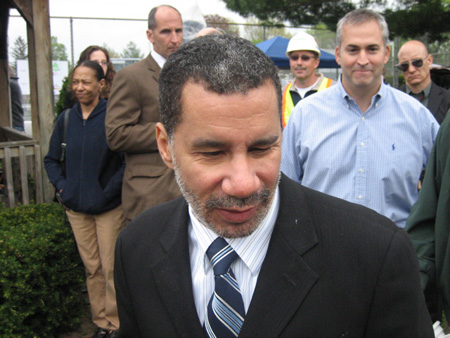 NYS Governor David Paterson On Morton Avenue Last Year
  Before, Second Avenue Furnace
  After, Second Avenue Furnace